Learning Activism: The Intellectual Life of Contemporary Social Movements by Aziz Choudry
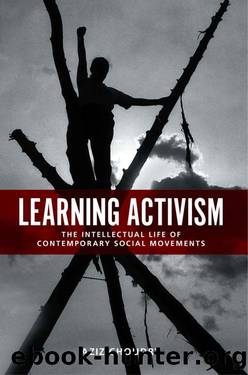
Author:Aziz Choudry [Choudry, Aziz]
Language: eng
Format: epub
ISBN: 9781442607934
Publisher: University of Toronto Press, Higher Education Division
Published: 2015-09-29T22:00:00+00:00
FIGURE 3.1: Blockade during the 16 April 2000 (A16) protests of the World Bank and International Monetary Fund in Washington, DC. (Photograph by Orin Langelle)
Music, Art, and Political Education
When formal political channels for sharing ideas, analysis, and experiences are not available, and even when they may seem to be, the arts and cultural approaches can provide powerful ways to approach political education work. Creative artists often express this directly, as when Australian singer-songwriter Shane Howard (2010, p. v) states, âSongs hold memory, document history, describe feelings, communicate ideas and are one of the most potent, portable and transmissible vehicles of thought and feeling in the human experience.â Reflecting on South African worker education during the struggle against apartheid, Vally, wa Bofelo, and Treat (2013, p. 470) concur when they write that informal education efforts included âa dizzying range of cultural and mass-media forms, including the writing and production of plays, poetry readings, songs and musical choirs, and dozens of community-based and trade union newsletters. These efforts aimed to provide everything from general literacy and technical work-related skills to running democratic and accountable union structures, organizing, political consciousness and social mobilization.â Large and small, movements and mobilizations across the world have been rich in places where politics, art, and education meet. These forms not only sustain movements but also connect across time and space with other moments, other struggles.
Like so many others, music and the arts have played a major role in my own politicization and political education. For me, Dykstra and Lawâs (1994, p. 122) insights are key to thinking about movements and the creative arts in that âthe full life of a social movementâpoetry, music, petitions, pickets, and so forthâbrings culture and politics together in an inherently educative way.â Robin Kelley (2002, p. 10) takes this even further when he writes, âIn the poetics of struggle and lived experience, in the utterances of ordinary folk, in the cultural products of social movements, in the reflections of activists, we discover the many different cognitive maps of the future, of the world not yet born.â
But these poetics of struggle can be so politically powerful that some artists have been banned or assassinated. Miriam Makebaâs citizenship was revoked by the apartheid South African state while overseas. Argentinian singer Mercedes Sosa was arrested, banned, and exiled by the military junta in her country. Pakistani revolutionary poets Faiz Ahmed Faiz and Habib Jalib were jailed. Nigerian musician and songwriter Fela Kuti was beaten and jailed for his musicâs trenchant social commentary and criticism of the military. Argentinian singer-songwriter Atahualpa Yupanqui was jailed under Juan Perón in the late 1940s and early 1950s for his Communist Party affiliation. Québécoise feminist/independence activist and singer Pauline Julien was one of many people attacked by police and jailed for several days during the 1970 October Crisis. The RCMPâs Security Service spied on Canadian singer Rita MacNeil while surveilling feminist organizations in the 1970s: âSheâs the one who composes and sings womenâs lib songs,â reported an RCMP memo (Hewitt & Sethna, 2012, p.
Download
This site does not store any files on its server. We only index and link to content provided by other sites. Please contact the content providers to delete copyright contents if any and email us, we'll remove relevant links or contents immediately.
| Anthropology | Archaeology |
| Philosophy | Politics & Government |
| Social Sciences | Sociology |
| Women's Studies |
Cecilia; Or, Memoirs of an Heiress — Volume 1 by Fanny Burney(32558)
The Great Music City by Andrea Baker(32018)
Cecilia; Or, Memoirs of an Heiress — Volume 2 by Fanny Burney(31956)
Cecilia; Or, Memoirs of an Heiress — Volume 3 by Fanny Burney(31940)
We're Going to Need More Wine by Gabrielle Union(19045)
All the Missing Girls by Megan Miranda(16023)
Pimp by Iceberg Slim(14506)
For the Love of Europe by Rick Steves(14121)
Bombshells: Glamour Girls of a Lifetime by Sullivan Steve(14073)
Talking to Strangers by Malcolm Gladwell(13370)
Norse Mythology by Gaiman Neil(13363)
Fifty Shades Freed by E L James(13239)
Mindhunter: Inside the FBI's Elite Serial Crime Unit by John E. Douglas & Mark Olshaker(9339)
Crazy Rich Asians by Kevin Kwan(9290)
The Lost Art of Listening by Michael P. Nichols(7506)
Enlightenment Now: The Case for Reason, Science, Humanism, and Progress by Steven Pinker(7311)
The Four Agreements by Don Miguel Ruiz(6763)
Bad Blood by John Carreyrou(6621)
Weapons of Math Destruction by Cathy O'Neil(6279)
